Two writers can both tell you they work in healthcare. One writes blog posts for a local clinic. The other prepares the documents that decide whether a new drug reaches patients. Their work shares a name and almost nothing else, including the paycheck. One can out-earn the other three times over.
That gap is the whole story. People talk about “healthcare writing” like it’s one job. It isn’t. It’s at least seven of them, each with its own clients, its own skills, and its own pay ceiling. I’ve spent my career writing healthcare content, and the question I hear most from people eyeing this field is which kind pays best. The honest answer takes more than a sentence, so let’s get into it.
TL;DR Quick Answers
Freelance Healthcare Content Writer
A freelance healthcare content writer is an independent, contract-based writer who turns medical information into clear, accurate content that patients can understand and find online. They write for clinics, practices, and health brands instead of working on staff.
What they produce: patient education articles, clinic and practice web pages, health blogs, and other search-optimized content.
Who they serve: healthcare providers and health companies that want to reach patients, not regulators or scientific peers.
How they differ from similar roles: a regulatory medical writer prepares FDA submissions and clinical reports for professional audiences. A healthcare copywriter writes to persuade and sell. A content writer informs clearly and helps the page rank.
What the work requires: strong research skills and a firm commitment to accuracy. A medical degree usually isn't needed for patient-facing work, but getting the facts right is non-negotiable.
A good freelance healthcare content writer earns their fee by making a practice easy to find: accurate content that ranks in search, and that patients trust the moment they land on it.
Top Takeaways
Healthcare writing isn’t one job. It’s seven kinds of work, and the pay gap between them is wide.
Regulatory writing has the highest ceiling and the highest hourly rates in the field, but it asks for science credentials and regulatory training.
CME, scientific publications, and medical communications make up a strong, well-paid middle, each one suited to writers who know clinical or research material.
Healthcare copywriting and healthcare SEO content are the most open doors. Neither needs a medical degree, and both scale fastest through retainers. It’s the path most freelance healthcare content writers take to build a business of their own.
The highest per-word rate rarely adds up to the highest yearly income. Owning one kind of work and pricing by the value of the project matters more than the niche itself.
Healthcare writing is a specialized branch of the wider website content writer field, and that specialization is exactly what earns the premium.
The Most Profitable Healthcare Writing Services, Ranked
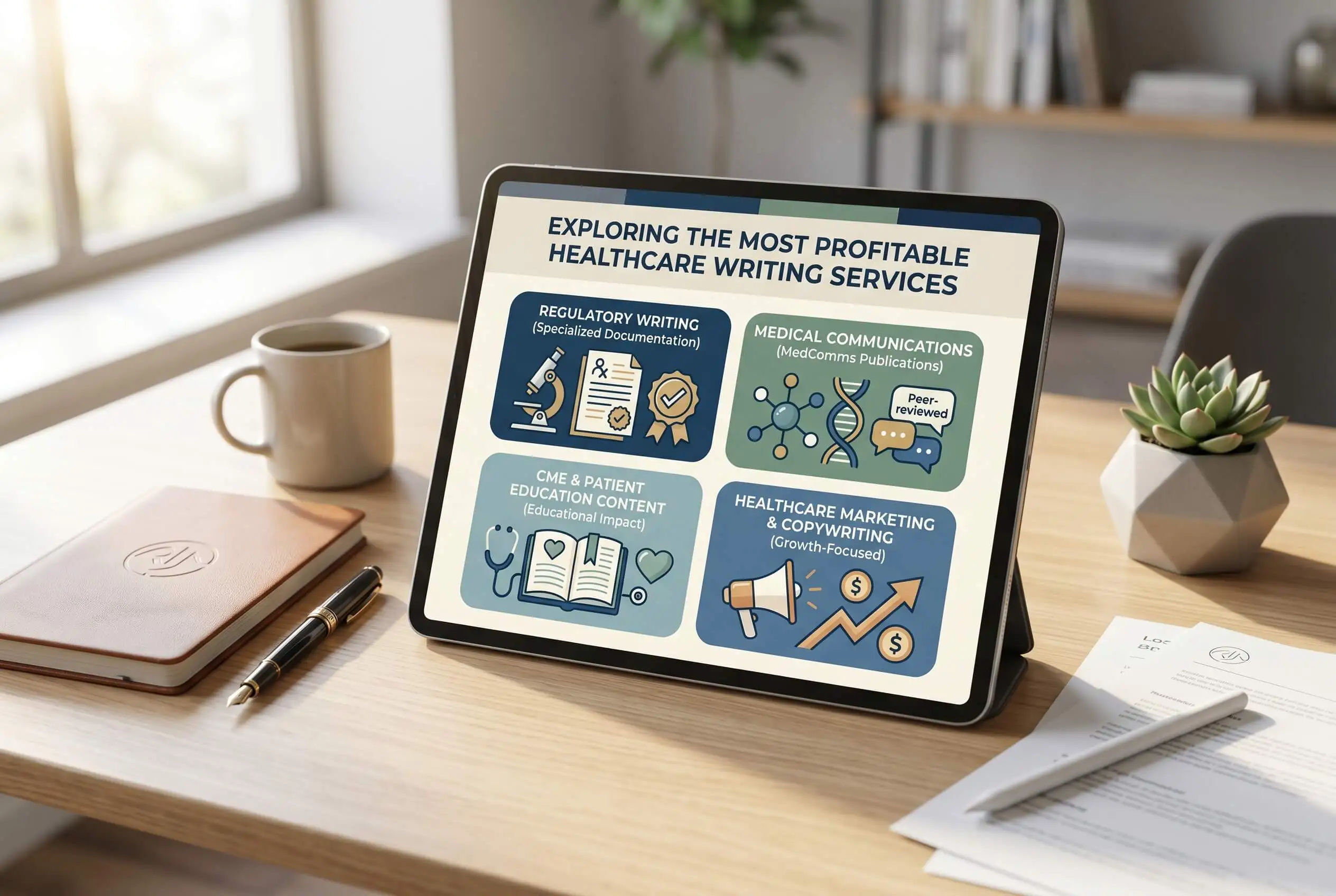
First, a quick word on what “profitable” even means here, because the numbers can fool you. Three of them matter: what you charge per word, what you charge per project, and what you actually take home in a year. They don’t always agree. A service can post a per-word rate that turns heads and still earn you less over twelve months than a steadier kind of work with duller headline numbers. Barrier to entry counts too. The list below runs from the highest ceiling down to the most open door, and I’ll be straight about the trade-offs at each stop.
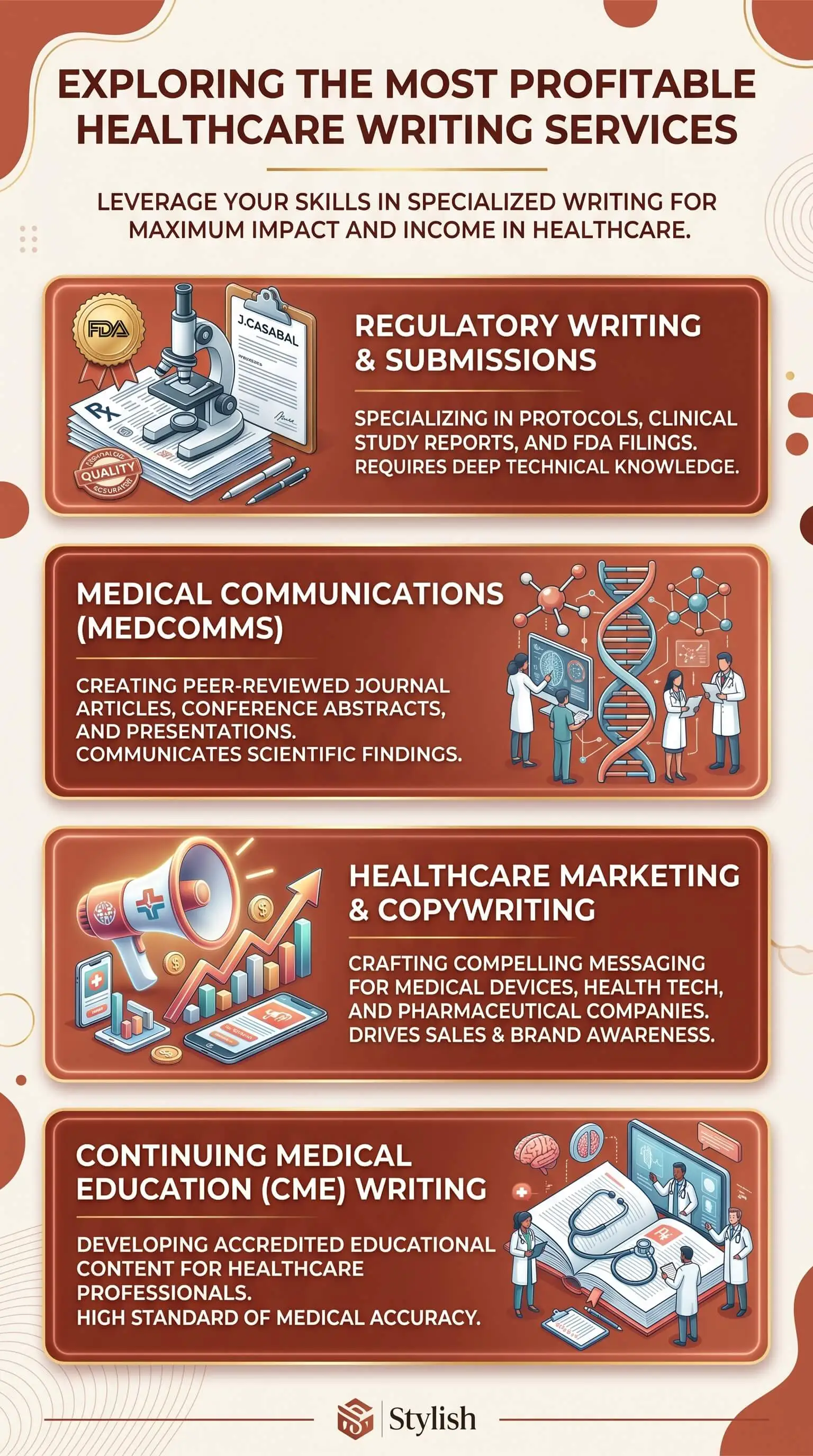
1. Regulatory Medical Writing
Regulatory writing sits at the top, and it isn’t close. These are the documents that move a drug or device toward approval: clinical study reports, clinical evaluation reports, submissions to the FDA and EMA, investigator brochures. AMWA’s compensation data puts experienced freelance regulatory writers above $130 an hour, and writers who focus on pharmaceutical work report six-figure annual income that climbs well past what most writing pays. So what’s the catch? Credentials. This work usually expects a science degree, often an advanced one, plus regulatory training, because one mistake in a submission carries real legal weight. Highest pay, steepest climb.
2. Continuing Medical Education (CME) Writing
CME writing is the sweet spot of the field. It pays well, and the work stays interesting. CME writers build the needs assessments, slide decks, learning modules, and outcomes reports that doctors and nurses use to keep their licenses current. Reported freelance income here ranks among the best in medical writing, and the work feeds straight back into patient care. You need real fluency in clinical subjects. You don’t need to prepare regulatory submissions, which makes CME a smart target for writers who know medicine but want the pressure dialed down a notch.
3. Scientific Publications and Manuscript Writing
Publications writers ghostwrite the peer-reviewed manuscripts, abstracts, and conference posters that carry medical research into print, and they often guide authors through picking a journal and getting through submission. It’s research-heavy work, and reported freelance income lands firmly in six figures. It’s also the most closely watched corner of healthcare writing, governed by strict rules on authorship and transparency. A research background and an advanced degree put you in the strongest position, and the Certified Medical Publication Professional credential tells clients you take those rules seriously.
4. Medical Communications and Promotional Writing
Medical communications is the commercial side of the house: key-opinion-leader presentations, product monographs, sales training, advisory board summaries, launch materials for drug and device companies. The pay is strong and the turnarounds are quick, though it generally sits a step below regulatory, CME, and publications work. The skill that defines it is balance. Every piece has to do a marketing job while staying inside strict rules on compliance and accuracy. Writers who like marketing and can hold that line do well here, often cutting their teeth inside a medical communications agency before going out on their own.
5. White Papers and B2B Health-Tech Content
Health technology is growing fast, and it buys long-form business content: white papers, case studies, research-backed reports for digital health companies, device makers, healthcare software firms, and even brands investing in specialized board game copywriting services for health education and patient engagement campaigns. Experienced writers charge project fees in the thousands and hourly rates well above standard content work, because every piece means real research and interviews with subject-matter experts. It rewards writers who can see the bigger picture and turn technical material into something a business buyer actually wants to read. No clinical degree required.
6. Healthcare Copywriting and Conversion Copy
Healthcare copywriters write to make something happen: landing pages, email sequences, ads, website copy for clinics, practices, and direct-to-consumer health brands. This is persuasion, not education, and its value rises with the revenue it brings in, which is why experienced copywriters move clients onto project fees and retainers instead of counting words. For a writer who can point to results, the ceiling is genuinely high. It also pairs naturally with healthcare content writing, since the same client usually needs both.
7. Healthcare SEO and Medical Content Writing
Healthcare SEO and medical content writing is the most open door of the seven, and that’s its strength, not its weakness. This is patient education, clinic and practice web pages, and health blogs built to rank in search and answer the questions real people are typing in. Expert content writers in healthcare report per-word rates from about $1.00 to $1.75, with project fees in the hundreds for a single well-researched article. Patient-facing work usually doesn’t ask for a medical degree, which lowers the barrier without lowering the bar for accuracy. It also scales better than anything else on this list, because clients need content month after month, and that turns into retainers. This is where most freelance healthcare content writers start. Plenty of them build a whole business on it, and I’m one of them.
So which one is best? None of them, and all of them. Regulatory pays the most per hour and asks the most of you up front. Healthcare SEO content asks the least and grows the fastest. From what I’ve seen, the writers who earn the most don’t scatter. They pick one of these as their home base, get genuinely good at it, then add a service their existing clients already need.
“Writers ask me which kind of healthcare writing pays the most. It’s the wrong question. The best-paid writers I know aren’t the ones chasing the highest per-word rate. They’re the ones who picked one type of work, got good enough that a client would put their own name on a recommendation, and then started charging for the value of the project instead of the length of it. Healthcare clients pay for accuracy and accountability. They are not paying by the pound. Figure that out early and you stop competing on price. You start getting hired on trust.”
Essential Resources
A handful of organizations carry most of the weight in this field: training, credentials, rate data, and the standards that keep the work honest. These seven are worth a bookmark no matter which path you pick.
American Medical Writers Association (AMWA). The main professional home for medical communicators in the US. It runs training, the Essential Skills certificate, and the Medical Writer Certified credential, plus a large library for members.
European Medical Writers Association (EMWA). AMWA’s counterpart across the Atlantic, with a well-regarded training program and two conferences a year. Useful wherever you’re based, not just in Europe.
Regulatory Affairs Professionals Society (RAPS). If regulatory writing is your target, this is where you want to be. RAPS offers courses, certification, and a deep library on regulatory documentation.
International Society for Medical Publication Professionals (ISMPP). The home of the publications crowd. ISMPP sets the ethical standards for the work and offers the Certified Medical Publication Professional credential.
AMWA Medical Communication Compensation Report. The most trustworthy income benchmark in the field, broken out by experience, work setting, and type of writing. Use it to set your rates, and to defend them.
AMWA 2024 Compensation Report Executive Summary. Not an AMWA member yet? This summary is free to read and gives you the headline findings from the latest survey.
Medical Writing journal (EMWA). EMWA’s quarterly journal is peer-reviewed and genuinely practical, with each issue built around a single theme.
Supporting Statistics
Three numbers put the earning power of this field in plain view.
The U.S. Bureau of Labor Statistics reported a median wage of $72,270 for writers and authors in May 2024, with the top 10 percent earning more than $133,680. Look at that spread. The distance between the middle and the top is what specialization buys you.
Technical writers, who work in a specialized, accuracy-first corner of writing, posted a higher median of $91,670 in May 2024, again from the BLS. Healthcare writing rewards that same kind of specialization.
The global medical writing market was worth roughly $5.07 billion in 2025 and is on track to reach $11.09 billion by 2033, growing close to 10 percent a year, according to Grand View Research. Demand is outrunning the supply of qualified writers, and that keeps rates from sagging.
Final Thoughts
If you want the single most profitable healthcare writing service, it’s regulatory writing. The numbers say so, and they reflect the stakes and the credentials behind the work. But the most profitable service and the right service for you are not always the same thing, and treating them as one is the most common mistake I watch writers make.
Here’s where I’ll be straight with you. For most people reading this, chasing the top of the ranking is the wrong move. Start with healthcare SEO content or healthcare copywriting instead. Neither asks for a clinical degree, both let you build a portfolio and a client list quickly, and both bring in the repeat work that turns into a stable income. Once you have that base, you can specialize upward as your skills and credentials grow.
The market is working in your favor. Demand for healthcare content keeps climbing, AI hasn’t pushed out the writers who are genuinely accurate and accountable, and clients still pay extra for someone they can trust with their reputation. Pick a lane, get good, charge for the value you create. The money follows the work.
Frequently Asked Questions
What’s the highest-paying type of healthcare writing?
Regulatory medical writing pays the most. Experienced freelance regulatory writers bill at the top of the whole writing market, a reflection of the credentials and the legal stakes the work involves. CME and scientific publications writing follow close behind.
Do you need a medical degree to be a freelance healthcare content writer?
No. Patient-facing healthcare content writing, including blogs, web pages, and patient education, generally doesn’t require a medical or science degree. It does require sharp research skills and a serious commitment to getting things right, since the content still affects how people manage their health. Regulatory and publications writing are the lines where advanced credentials are usually expected.
How much does a freelance healthcare content writer make?
It depends heavily on which kind of work you do and how experienced you are. Expert healthcare content writers report the per-word rates noted earlier, while regulatory and CME specialists report six-figure annual income. The fastest way to raise what you earn is to stop billing by the word and start billing by the project or on retainer.
Should I charge per word or per project?
Per project or on retainer, almost every time, once you have some experience. A per-word rate ignores the research, the interviews, and the rounds of revision that healthcare work demands, so it quietly underpays you on the hardest jobs. Price the finished piece by what it’s worth, and what you earn finally matches what the work actually takes.
Is healthcare writing safe from AI?
It’s one of the safer kinds of writing to be doing right now. Regulatory submissions, CME, and publications carry legal and patient-safety stakes that need a credentialed, accountable human behind them, and no client is handing that responsibility to an unsupervised tool. AI helps with drafting and research. The judgment and the accountability stay with the writer.
How do I get started in healthcare writing?
Start with one of the more open lines, usually healthcare SEO content or copywriting, and build a focused portfolio. Add training or a credential through a body like AMWA or EMWA, get comfortable interviewing subject-matter experts, and specialize toward the higher-paying work as your credentials and client base grow.
Take the Next Step
Don’t overthink the choice. Pick one service line from this list, the one that fits the background you already have, and give it the next ninety days. Build three solid portfolio pieces. Study the rate data so you know your worth before you ever quote a price. Then bill your next project by the value it delivers, not the words it contains. Healthcare clients are out there right now looking for writers they can trust, and the market is tilting your way. For more honest, no-nonsense guides for healthcare writers