You probably found Internal Family Systems somewhere between a book and a bad week. One idea stuck. You're made of parts, and none of them is the enemy.
Living with a wound that won't close wears on more than skin. So does caring for someone who has one. Even with support from wound care specialists, the waiting and the pain tend to wake up parts that worry or criticize, and sometimes a part that just goes quiet. That's often when people start searching for an IFS therapist in Seattle.
The short answer comes first.
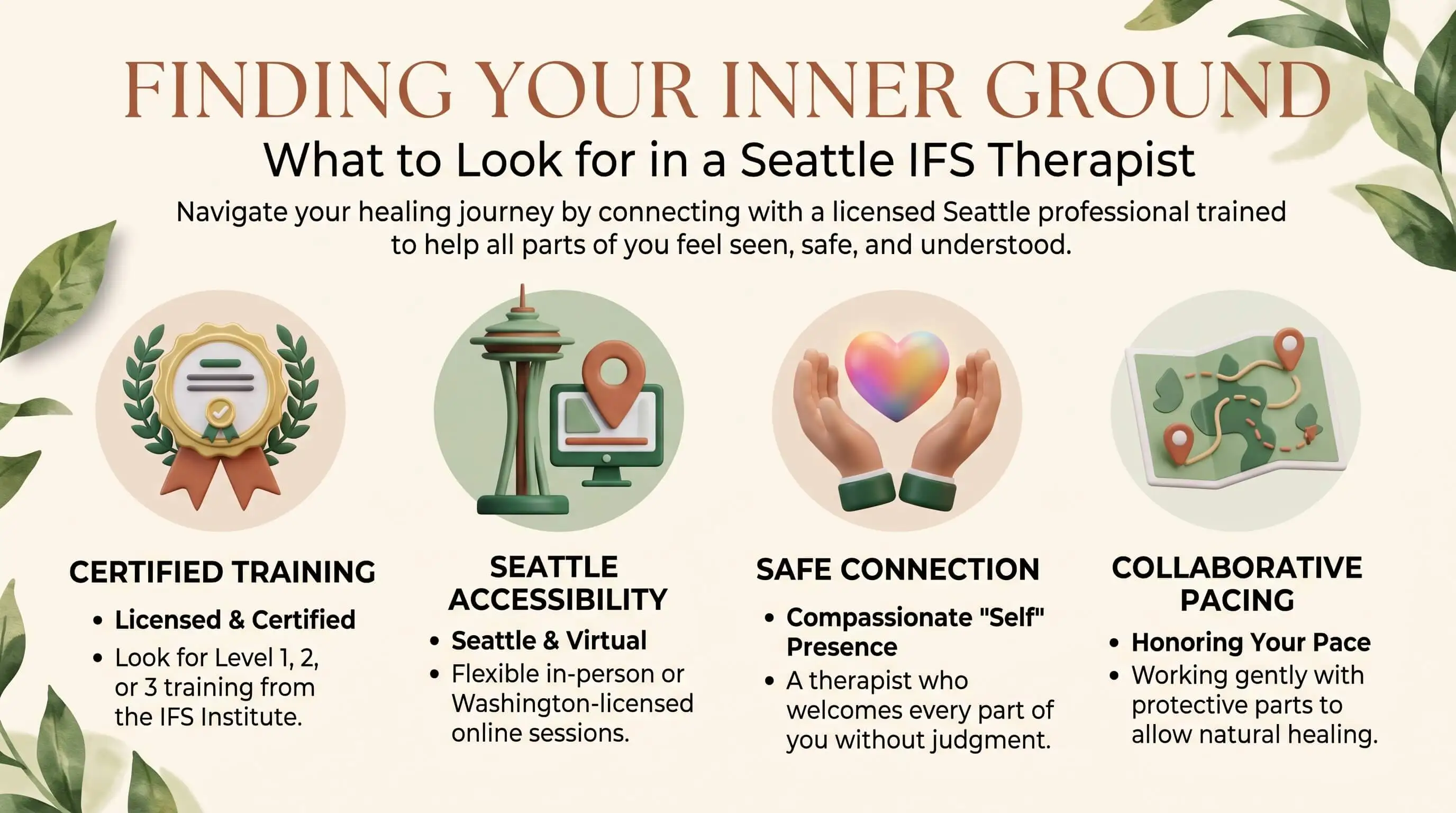
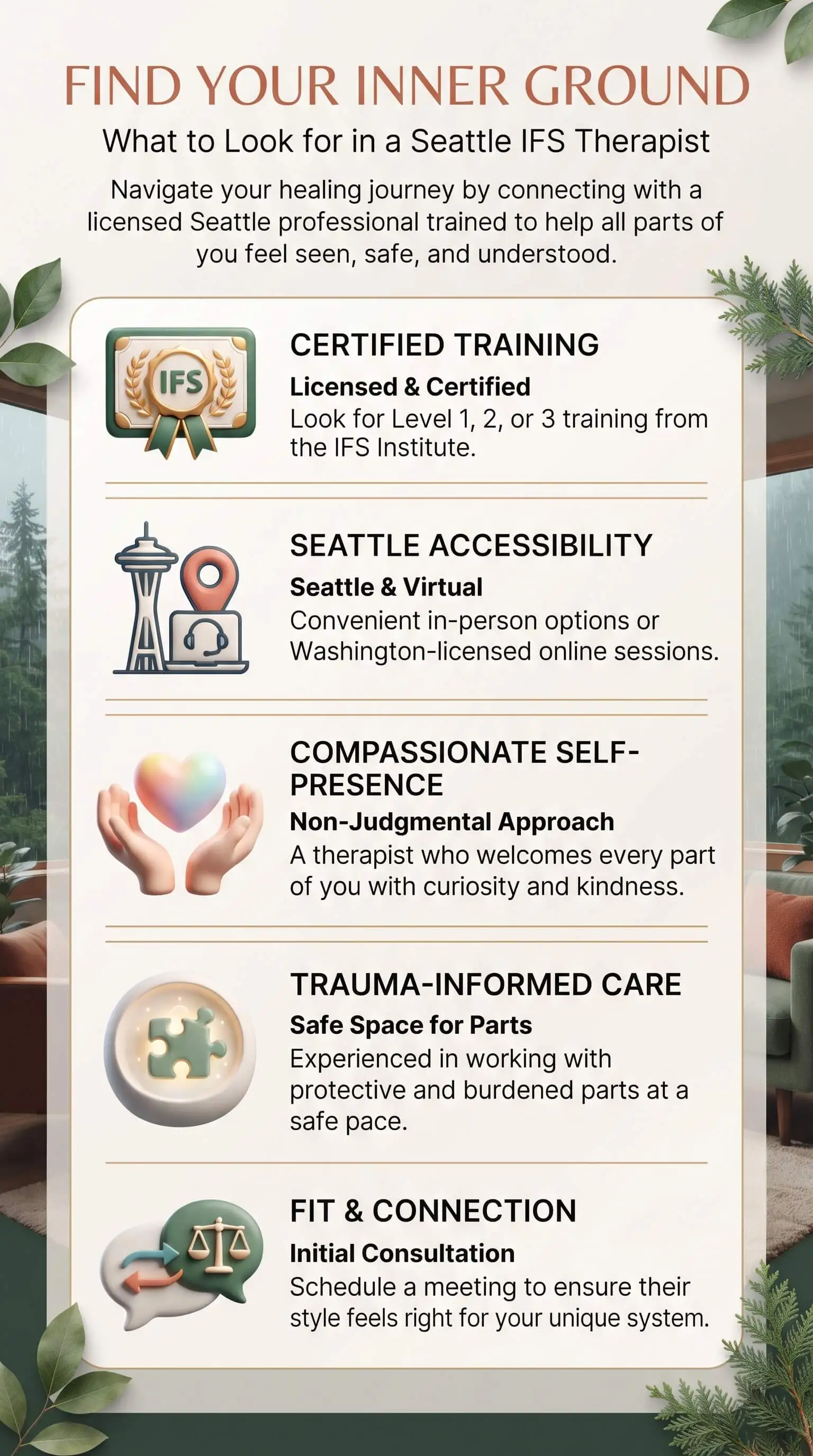
Look for an active Washington license, IFS Institute Level 1 training or higher, experience with what you're carrying, and a therapist who lets you set the pace. Credentials earn someone a spot on your list, and the first conversation tells you whether they stay on it.
TL;DR Quick Answers
IFS Therapist Seattle
A good IFS therapist in Seattle holds an active Washington license and IFS Institute Level 1 training or higher, and lets you set the pace. In IFS, going slowly is part of the method, so be wary of anyone who promises fast results.
License: LMHC, LICSW, LMFT, or psychologist, which you can verify on the Washington State Department of Health's Provider Credential Search.
Training: Level 1 is the minimum. Level 2, Level 3, and IFS certification mean more training, though not necessarily a better fit.
Experience: Look for regular work with what you're carrying, such as trauma, anxiety, relationships, or chronic illness.
Location: Any Washington-licensed IFS therapist can usually see Seattle clients by secure video.
Fit: The client-therapist relationship is one of the strongest predictors of how well therapy works.
First step: Book a free 15-minute consultation and ask about training, pacing, and fees.
Top Takeaways
Confirm a Washington license before anything else, since IFS training and licensure are separate.
Level 1 is the minimum for calling oneself IFS-trained, and certification is its own supervised process.
Choose someone who regularly works with what you're carrying, whether that's trauma, anxiety, relationships, or chronic illness.
Fit and pacing matter as much as credentials, and decades of research back that up.
Any Washington-licensed clinician can usually see Seattle residents by video.
Use the free consultation to ask direct questions, and notice how you feel while you ask them.
Check the Washington License Before the IFS Training
A license lets a clinician practice therapy. IFS is a method they choose to learn on top of it, and no IFS certificate replaces the license underneath.
If you're in Washington when you sit down for a session, your therapist needs a Washington credential. Usually that's an LMHC, LICSW, LMFT, or a licensed psychologist.
Checking takes about two minutes. Type the therapist's name into the Washington State Department of Health's Provider Credential Search and you'll see their license type and status, any current restrictions, and any disciplinary action going back to July 1998.
Do this even if you found them through the IFS Institute while searching for IFS therapy. The Institute's directory says plainly that it isn't a licensing board and hasn't independently verified what practitioners list about themselves. Find names there. Confirm them with the state.
What IFS Level 1, Level 2, Level 3, and Certification Mean
Most people get tangled up here, so here it is plainly.
Level 1 is the Institute's foundational training and the minimum before a clinician can call themselves IFS-trained.
Level 2 builds on Level 1 and goes deeper into specific topics.
Level 3 is advanced training. By the Institute's own description, a higher level means more training completed.
Certified IFS Therapist is a separate process in which a clinician demonstrates competence in the model. Everyone certified has finished at least Level 1, and certification doesn't widen what their license lets them do.
A training level shows what someone studied, though it can't show you how it feels to sit across from them.
A Level 1 clinician with years of trauma work behind them may suit you better than a newly certified one who rarely sees your kind of pain. Ask about training, then weigh it with everything else.
Match Their Experience to What You're Carrying
IFS can help with a wide range of concerns, but each therapist tends to see some far more than others. Look for someone who works with people like you week after week.
Trauma and complex PTSD. Ask how they pace it. Trauma-informed IFS gets to know the parts guarding a painful memory long before it goes near the memory itself.
Anxiety and perfectionism. These usually show up as protectors that have worked overtime for years. A good fit treats them with respect.
Attachment and relationships. Old patterns tend to replay with partners, family, and coworkers. Ask how they work with the parts that take over in those moments.
Chronic illness, pain, and slow healing. A body that won't cooperate brings its own grief, and often fear. If that's part of your story, mention it on the first call and listen to how they respond.
Two questions are worth asking every therapist on your list:
How often do you work with people dealing with what I'm dealing with?
What happens if a part of me doesn't want to be here?
That second one tells you a lot. IFS doesn't pathologize, so a part that resists therapy isn't failing at anything. It has a job, usually a protective one, and a good IFS therapist gets curious about it instead of pushing past it.
How a Good Fit Feels
Most people can tell within a session or two. It's working when:
you feel listened to, not managed
you and your therapist agree on the pace
your doubts are welcome in the room
they're honest about what therapy can't promise
Be wary if you notice any of these:
guaranteed timelines or promised results
pressure to go straight into traumatic memories
vague or defensive answers about training or licensure
a therapist who treats your hesitation as an obstacle instead of information
a sense that you're being handled rather than helped
Fit matters for more than comfort. Researchers have studied the client-therapist relationship for decades, and its strength consistently tracks with how well therapy works. You'll find the numbers in the statistics section below.
Online IFS Therapy From Anywhere in Washington
Your therapist doesn't have to live in Seattle.
Licensing follows the state line, so a Washington-licensed clinician can usually see you by video anywhere in the state. Grow Therapy makes the same point about online care, noting that you can see anyone credentialed in your state. If the clinicians closest to you are full, that opens up a lot of options for online IFS therapy in Washington.
Parts work tends to hold up well on video. Many people find it easier to turn inward from their own couch than from an office across town, and on days when your body is sore or tired, skipping the drive counts for something. Some practices, including this online IFS therapist for Seattle clients, work entirely by secure video across Washington.
Before your first session, read through the HHS guidance on preparing for a telehealth visit. It lists the equipment most visits need, which is internet access plus a phone, tablet, or computer. It also covers what to do when the connection drops and notes that your cost depends on your insurance.
Cost, Insurance, and the Free Consultation
Across the Seattle-area and Washington listings we reviewed, therapists who use IFS charged roughly $140 to $225 a session. Some are in-network with Washington plans like Premera, Regence, Aetna, Cigna, or Blue Cross Blue Shield. Others work out-of-network and can give you paperwork to submit for reimbursement.
Most offer a free consultation, often 15 to 30 minutes long. Use it, because it's the most useful tool you have. A few things to ask:
Are you licensed in Washington, and what's your credential?
How far have you gone in IFS training?
How much of your caseload looks like what I'm dealing with?
What do you charge, and do you take my insurance?
Then notice how your body reacts to their voice. That counts as information too.
"Going slowly is the method itself, not a preference I happen to have. Anyone promising you speed is selling you something."
7 Essential Resources
1. IFS Institute Practitioner Directory
The main directory of IFS-trained clinicians. You can search by location, and each listing shows a training level and certification status. Start your shortlist here. ifs-institute.com/practitioners
2. Washington State Department of Health Provider Credential Search
Confirm a therapist's Washington license, whether it's active, and any disciplinary history before you book. doh.wa.gov Provider Credential Search
3. Telehealth. HHS.gov for Patients
The U.S. Department of Health and Human Services guide to virtual visits. It walks through scheduling, equipment, payment, and what to do when the technology acts up. telehealth.hhs.gov/patients
4. IFS Certification Eligibility Requirements
The Institute's own explanation of what certification requires and what it leaves unchanged, including a clinician's scope of practice. Handy when a directory listing throws several credentials at you. IFS Institute Help Center
5. The Alliance in Adult Psychotherapy
A large meta-analysis on the client-therapist relationship, published through the Society for the Advancement of Psychotherapy. If you want the evidence behind "fit matters," start with this one. societyforpsychotherapy.org
6. IFS Treatment for PTSD and Comorbid Conditions: Pilot Study
A summary of one of the first studies of IFS with adults who had PTSD and histories of childhood trauma. Worth reading if trauma is part of why you're looking. ifs-institute.com research
7. 988 Suicide & Crisis Lifeline
Therapy isn't a crisis service. If things feel urgent, call or text 988 or chat online, any hour of the day, free and confidential. 988lifeline.org
3 Statistics
1. The Relationship Predicts Results
Researchers pooled 295 independent studies covering more than 30,000 patients and found a consistent link between the therapeutic alliance and outcomes, with a correlation of .278. The link held across treatment approaches, patient types, and countries. Source: Society for the Advancement of Psychotherapy
2. Early IFS Research on Trauma Looks Promising
In a pilot study, 13 adults with PTSD completed 16 sessions of IFS. When the study ended, and again a month later, only one of them still met the criteria for a PTSD diagnosis. The researchers also reported significant drops in depression and dissociation. The study was small and had no control group, so read it as a hopeful early signal rather than proof. Source: IFS Institute
3. Access in Washington Is Tight
Using federal HRSA data, 2024 reporting counted 39 designated mental health shortage areas across 36 Washington counties. About 2.2 million residents, or 28.2% of the state, were underserved. That's one more reason to search statewide by video instead of stopping at the Seattle city limits. Source: Stacker
Research shows that a strong therapist-client relationship can improve treatment outcomes, while early IFS studies suggest promising results for trauma recovery. With limited access to mental health care in Washington, online IFS therapy offers another way to find qualified support. A freelance healthcare content writer can help make information about IFS therapy, therapist qualifications, and available treatment options easier to understand.
Final Thoughts and Opinion
Check every credential. A Washington license isn't negotiable, and Level 1 IFS training is the floor. Ask directly how much experience they have with your kind of pain.
None of that settles the choice on its own, though.
The research keeps coming back to the relationship, and IFS makes the same argument in its own language. Parts heal when they feel safe enough to be known. Whether that happens depends on who's sitting with you and how they hold the pace, far more than on the level printed next to their name.
If you're already worn out from a body that heals slowly, or from caring for someone who's struggling, you don't need a therapist who adds pressure. Look for one who can stay steady on the days you can't.
Verify first. Then pick the person your system relaxes around.
Frequently Asked Questions
What Qualifications Should an IFS Therapist in Seattle Have?
At minimum, an active Washington license, such as an LMHC, LICSW, LMFT, or psychologist credential, plus completed IFS Institute Level 1 training. After that, look for experience with your specific concerns. You can verify the license on the Department of Health's Provider Credential Search and check training in the IFS Institute directory.
What's the Difference Between an IFS-Trained and an IFS-Certified Therapist?
IFS-trained usually means the clinician has finished at least Level 1. IFS-certified means they've also completed a separate process that demonstrates competence in the model. Certification shows extra study and review. It doesn't expand what their license allows, and it doesn't guarantee they're the right person for you.
Can I See an IFS Therapist Online if I Live in Seattle?
Yes. Licensing is state-based, so a therapist licensed in Washington can usually see you by secure video anywhere in the state. Parts work tends to translate well to video. Just make sure the platform is secure and that you have a private spot where nobody can overhear you.
How Much Does IFS Therapy Cost in Seattle?
In the Seattle-area and Washington listings we reviewed, sessions ran roughly $140 to $225. What you pay depends on the clinician, the session length, and your insurance. Many therapists offer a free 15 to 30 minute consultation where you can ask about fees up front.
Does Insurance Cover IFS Therapy in Washington?
Often, yes. Insurers generally cover psychotherapy from a licensed provider rather than a specific method. Some Washington IFS therapists are in-network with plans like Premera, Regence, Aetna, Cigna, or Blue Cross Blue Shield. Ask the therapist, then confirm your mental health benefits with your plan so the bill doesn't surprise you.
How Do I Know if an IFS Therapist Is the Right Fit?
Notice how you feel during and after the first couple of sessions. A good fit feels collaborative and unhurried, and your therapist welcomes your hesitation rather than overriding it. If you feel pushed or unheard, it's fine to keep looking. The relationship is one of the strongest predictors of how well therapy works.
Is IFS Therapy Evidence-Based?
The evidence is growing. Early research, including a pilot study with adults who had PTSD, has shown promising results, and the researchers behind it planned a larger controlled trial. IFS is younger than some approaches, so the research is still catching up. Many clients value how gently it works with trauma and anxiety.
Start With One Conversation
You don't need to have it figured out before you reach out. You don't need to understand IFS or know which part is which, and you don't have to feel completely ready.
A short consultation is enough to find out whether someone feels steady to you. If you're in Washington and want to work with a licensed IFS therapist by secure video, Lauren Rath Therapy offers free consultations for adults across the state, Seattle included.
It's fifteen minutes, it's free, and nothing is expected of you after.


